Everyone is doing Tokenized Stocks wrong
There’s been a great misunderstanding of what tokenized stocks are, and who they’re for.
Tokenized stocks are not equivalent to another “crypto asset to be traded,” contrary to how they’re being treated among the exchanges and wallets who’ve haphazardly implemented them.
My view is that tokenized stocks are far more comparable to stablecoins than they are to crypto assets: in adoption profile, design, and in utility.
Stablecoins are blockchain’s greatest product to date because they make the dollar permissionless.
Tokenized stocks are the next because they do the same for U.S. equities.
Stablecoins
Why are stablecoins valuable, and who are they most useful for? The answer is straightforward: stablecoins, specifically USD-pegged ones like USDC, are a democratization of the ability to hold and spend a stable medium of exchange.
For U.S. citizens, USDC’s primary value proposition is unobstructed, lower-cost value transfer (often more valuable for international transfer rather than domestic). Whereas for emerging markets, the value proposition is protection from inflation, access to advanced financial instruments, and stable exchange (locally and internationally). USDC is a Freedom Technology.
Because of this, it’s no surprise that stablecoins have been most successful in penetrating retail within emerging markets.
Stablecoin penetration is well under 10% in the United States, primarily because its core features are already met or rivaled by the public and private infrastructure we have access to.
Nigeria moves $92 billion a year through crypto, with stablecoins comprising roughly 43% of all Sub-Saharan Africa’s crypto activity: figures that have been climbing rapidly year-over-year. Vietnam has around 18% crypto adoption, sitting fourth globally on the Chainalysis Adoption Index, with stablecoin penetration likely close to 10%, if not higher. That’s a lot of people, with a ton of room to grow.
This goes on as a trend, and we tend to see higher stablecoin adoption based on the stability of a region’s currency. For example, stablecoins make up 61.8% of Argentina’s crypto volume.
Stablecoins settled $33 trillion in raw transfer volume in 2025! Goldman Sachs estimates that two-thirds of stablecoin supply is held in emerging markets. Standard Chartered forecasted that up to $1 trillion would move from bank accounts in emerging markets to stablecoins over the next few years.
Stablecoins have seen success because they’ve delivered permissionless dollar-denominated value and exchange to millions of people that this was previously unrealistic for.
The stablecoin thesis is consistent here and has already won the hearts and minds of Silicon Valley, for good reason.
“Dollar access is the wedge. Once a user has a stable, dollar-denominated balance — whether they’re a small business owner in Lagos, a freelancer in Buenos Aires, or a saver in Jakarta — they have the on-ramp to a full suite of financial products they’ve never meaningfully had access to before: credit, investing, wealth management, insurance.”
— a16z, in their piece detailing stablecoins as the “new stack for global finance.”
I agree!
Tokenized Stocks
Who are tokenized stocks for? Well, the same people that stablecoins are for: emerging markets that benefit from high-quality financial instruments.
Tokenized stocks and stablecoins are tightly linked, they both converge on the same audience, and benefit that audience in similar ways. With the core difference being that tokenized stocks export growth, while stablecoins export stability.
This means that tokenized stocks need to be offered in a similar capacity to stablecoins: they must be permissionless, and they must be USDC-native.
They need to be openly available for anyone, in virtually any region, to buy using USDC they hold onchain in less than 30 seconds, without paying enormous spread.
The stablecoin thesis is such that billions will have open, free, permissionless access to the U.S. dollar, untied from traditional finance rails and oversight.
The tokenized stock thesis should be exactly the same.
As of today, tokenized stocks sit in an awkward middle ground, useful to almost nobody at the scale they should be.
They generally come in two forms: permissioned broker-dealer rails, and permissionless AMM pools.
And for some reason, most incumbents are trying to optimize tokenized stocks to be direct mirrors of securities, making them as close-to-identical as possible, allowing for native brokerage redemption, voting rights, etc.
No one holds stablecoins because they can redeem at Circle or Tether for bank dollars, but because they’re permissionless exposure to the U.S. dollar.
Tokenized stocks should follow the same pattern.
If tokenized stocks are only ever offered through permissioned broker-dealer rails, which are just onchain receipts of brokerage transactions, with the same limitations and requirements, they aren’t much better than just using traditional brokers, like IBKR.
Designing tokenized stocks in such a way that sacrifices the primary benefits of the technology so end-users have redemption capabilities and ownership rights is a complete misalignment of what these assets are good for.
Is the vision here really just a brokerage that you can fund with crypto?
At the other end of the spectrum, there’s an inverse mistake being made: attempting to achieve permissionlessness through AMM-style decentralized exchanges.
Those who do this are still following this ‘backed 1:1’ model, as these onchain prices rely on arbitrage through minting and redemption. KYC’d participants can arbitrage a difference between the onchain price and the NAV: mint when the token trades rich, redeem when it trades cheap. This is a pretty common model and extends to many stablecoin issuers.
For stablecoin issuers, the redemption value never moves, and the redemption window never closes! So this is a relatively efficient mechanism to ensure stability, given solvency of the issuer.
Stocks, on the other hand, are neither stable nor redeemable around the clock, and thus the arbitrage is relatively inefficient.
So these tokens trade in a visible band around the underlying price, often tens of basis points wide.
Another issue is that liquidity has to be seeded and upheld by the issuer, because LPs in equity-linked markets face pure adverse selection. Price discovery happens on NASDAQ, so every informed trade is against the LP. There’s no intrinsic economic incentive to provide liquidity against an externally-determined fair value, unlike in crypto-assets where the pool itself is the site of price discovery. Unless, of course, you introduce pool fees to compensate LPs. But, by doing this, the price will deviate within the band of that fee as the profit margin for arbitrage changes accordingly.
To make this whole thing feel less abstract, let’s look at a snapshot of tokenized AMZN across xStocks and Ondo venues, then compare them to the NASDAQ price.
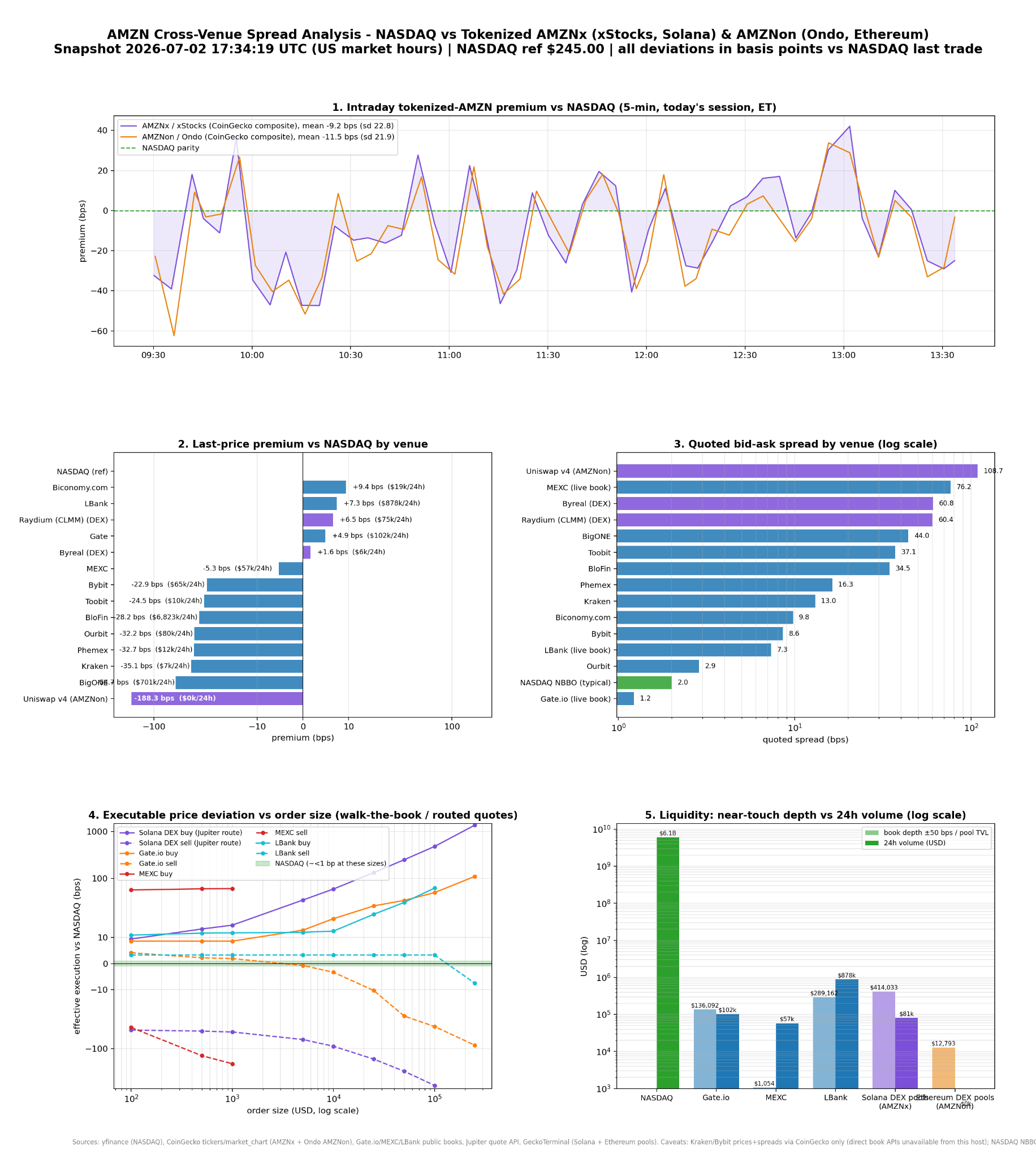
Huge variance in deviation from NASDAQ, and the direction of that deviation, between venues. Excluding the stale onchain pools, AMZNx spanned roughly 64bps between venues, and AMZNon around 68bps. There’s a lack of reliable price discovery here.
AMZN is one of the most liquid equities on Earth. If my brokerage quoted me AMZN 30bps away from the market price, I would move brokers.
And the execution inefficiency scales with size, unsurprisingly given we’re using an AMM after all. Significant size starts costing you 100bps+.
Even QQQ suffers from these issues, despite being perhaps the most liquid, most vanilla instrument you could put onchain. If any onchain equity trades tightly, it’d be QQQ.
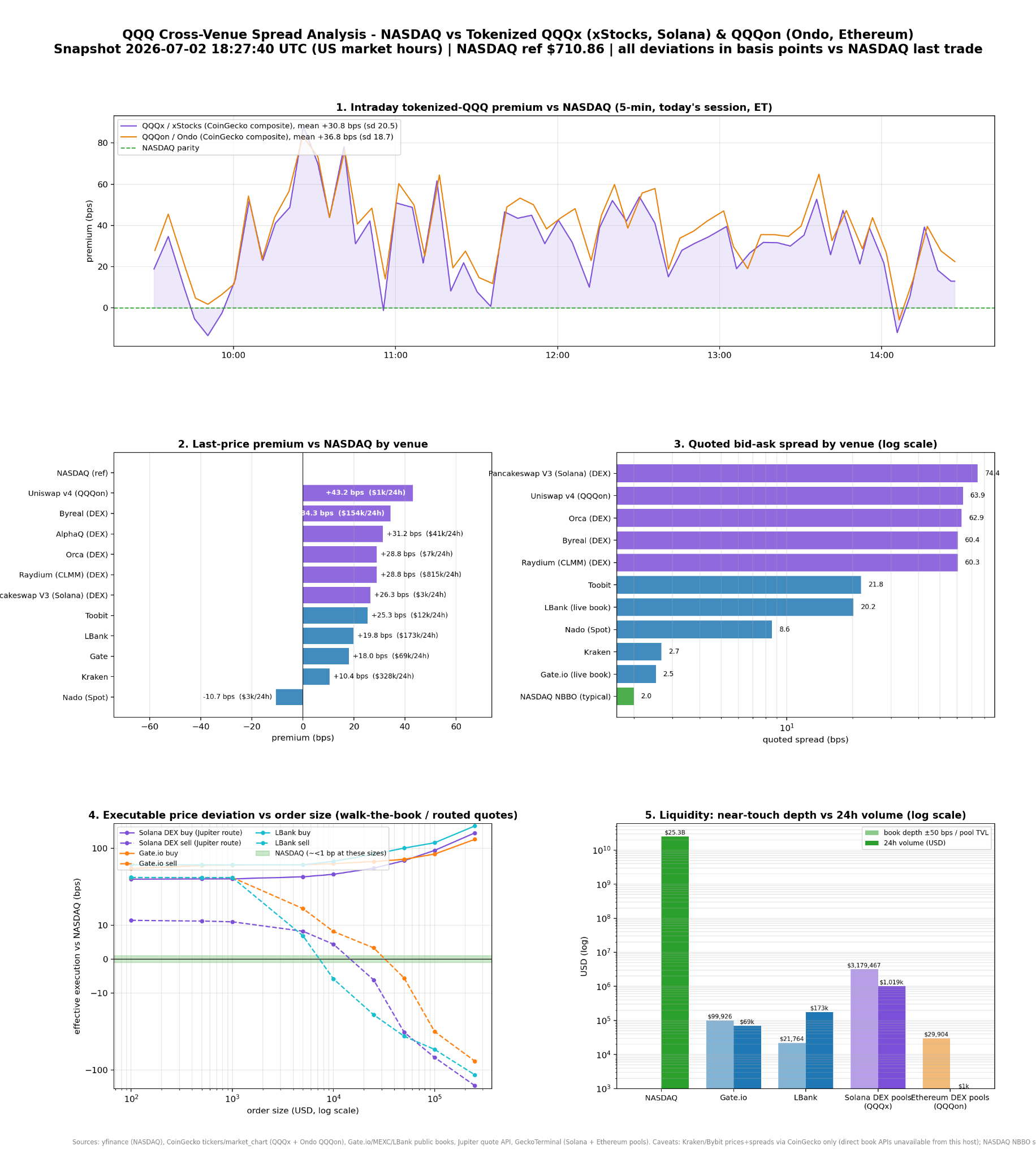
While not suffering as much venue-to-venue variance as AMZN, QQQ averaged around 31–37bps rich across the two issuers.
The challenge with this is, yet again, a misunderstanding of what users want. Yes, this model does allow for permissionless trading, but at the expense of reliable pricing, fees, and user experience.
And, on top of this, users pay an enormous cost between slippage, potential pool fees, and MEV!
Yikes. We’ve somehow managed to make the most liquid stocks on Earth massively inefficient for international traders.
This model sounds great theoretically: stocks completely backed 1:1, fully onchain for anyone to trade, totally permissionless and composable. Great! But it does not deliver what users need.
All of this lines up with a recurring mistake made by crypto companies: confusing theoretical purity with user value. Users do not care that something is architecturally elegant if it does not let them do something well that they could not easily do before.
And as a result of this misalignment, the penetration has been horrible.
Stablecoins have hundreds of millions of users. Tokenized stocks have fewer than 500,000. After more than a year of “launches” from major exchanges, the entire vertical, between CEXs and DEXs, trades roughly $160M in daily volume, which is less than 3 minutes of NVDA trading. And, of that, only about 5% actually trades onchain.
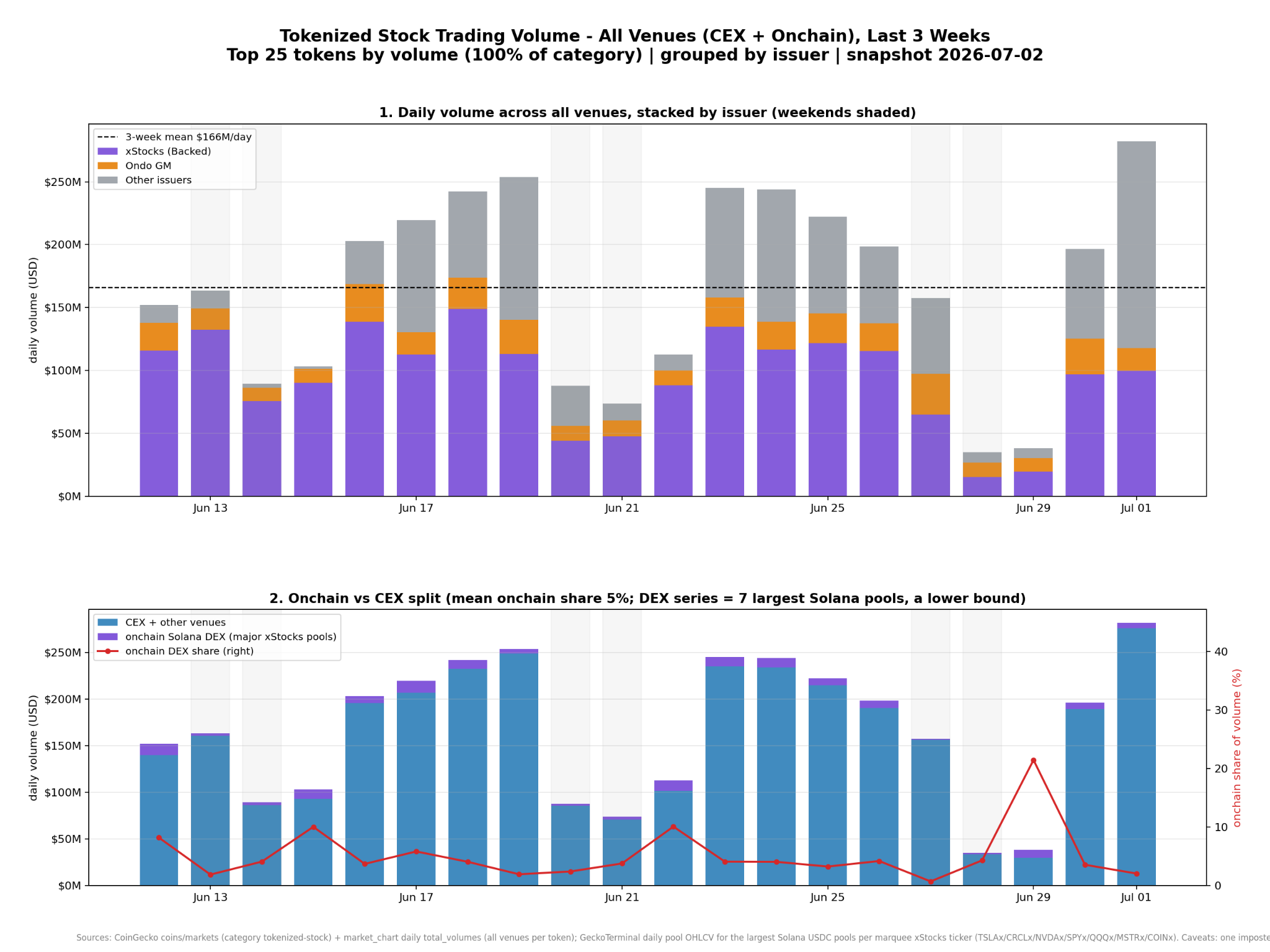
Your favorite centralized exchange #23 introducing tokenized stocks will not change this, because it fails to address the core problem.
The core problem is this: tokenized stocks have been miscategorized, forced into a grey area between permissioned TradFi securities and crypto assets.
Pillars, not Ghosts
If stablecoins are the foundation of the new global digital economy, tokenized stocks are the pillars.
To realize the full potential of these assets, they need to be built around what users actually want:
- They need to be USDC-native, and lack strict KYC.
- They need to be accessible to all emerging markets.
- They need to have deep liquidity, extremely accurate pricing, transparent fees, and be available to buy or sell with reasonable execution 24/7.
Don’t let tokenized stocks simply be ghosts of a bygone, segregatory system. We can do better, and we will.